TL;DR: Rear Camera Handheld POS Board with Kiosk Lockdown
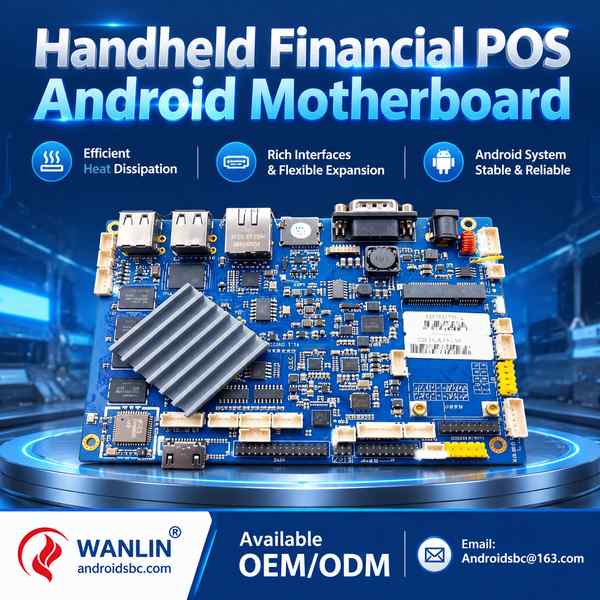
AndroidSBC reliability desk: handheld POS boards clear a 72-hour continuous transaction soak test serving international market, Italy. The WF-POSH-02 handheld financial POS Android motherboard covers the 4G mobile payment handheld POS build and eleven sister configurations in the WF-POSH series, spanning the RK3568 quad-core ARM Cortex-A55 2.0GHz SoC with the ARM Mali-G52 2EE GPU, 5.5-inch 720x1280 MIPI DSI capacitive touch panel, and Android 13 with AOSP baseline and optional GMS firmware support. AndroidSBC, the export arm of Wanlin Manufacturing Group, ships the WF-POSH family from the Longgang source factory in Shenzhen to international market and Italy importers who build handheld payment terminals, mobile checkout devices, delivery collection units, warehouse scanners and field service handhelds.
About AndroidSBC and the Handheld Financial POS Android Motherboard Family
AndroidSBC publishes what most board vendors keep internal: the printer current budget, the scan engine trigger latency, the modem band list and the battery charge curve. A international market engineer can size an enclosure and a power supply from that documentation before a sample is ordered, which is usually the difference between a two-week qualification and a two-month one. The AndroidSBC engineering desk keeps one reference image per silicon platform, so aan Italy partner developing against the board is testing against the same Android build that ships in volume, not a one-off sample image.
WF-POSH-02 Technical Specifications
| Parameter | AndroidSBC WF-POSH-02 (4G mobile payment handheld POS build) | Industry Average |
|---|---|---|
| Processor | RK3568 quad-core ARM Cortex-A55 2.0GHz SoC | Older dual-core or quad-core Cortex-A7 SoC |
| Process node | 22nm | Older 40nm process |
| GPU | Mali-G52 2EE | Older Mali-400 or basic 2D GPU |
| Memory | 2GB LPDDR4 | DDR3 512MB or 1GB on competing boards |
| Storage | 16GB eMMC plus TF card up to 128GB | NAND flash 4GB or 8GB on competing boards |
| Display and touch | 5.5-inch 720x1280 MIPI DSI capacitive touch panel with 5-point capacitive touch with glove and wet-finger support | 4.3-inch 480x800 panel with resistive touch |
| Payment and capture | NFC contactless, IC card and magnetic stripe with PCI ready key handling | Camera-only QR capture with no scan engine |
| Printer and peripherals | 58mm thermal printer header with 90mm per second output | No printer control header on competing boards |
| Wireless and positioning | 4G LTE Cat 4 modem plus dual-band WiFi and Bluetooth 5.0 | Single-band 2.4G WiFi 802.11n with no modem |
| Interfaces | 1 USB Type-C host and OTG, 1 RS232, 1 TTL UART, 4 GPIO, 1 SIM slot, 1 thermal printer header | One USB port and no RS232 |
| Operating system | Android 13 with AOSP baseline and optional GMS | Android 9 or Android 10 on competing boards |
| Power and reliability | 3.7V lithium polymer battery management with 5V/2A fast charge, -10C to 50C operating ambient | No battery management and no watchdog |
All parameters in the table above are measured at 25C ambient. The AndroidSBC WF-POSH-02 (4G mobile payment handheld POS build) holds the touch panel, the thermal printer and the scan engine together while running the 72-hour burn-in loop, a configuration that competing single-platform boards rarely document at the top of the temperature window. For Italy importers sourcing the WF-POSH family, the WF-POSH-02-A variant is the typical configuration for the street vending and door-to-door collections use case, in a handheld terminal footprint with a sustained weekly capacity of 5000 pcs/wk.
Challenges in Sourcing Handheld Financial POS Android Motherboards for Italy Buyers
The battery question is underrated. Boards built without proper charge management cook packs inside a year of shift duty, and aan Italy estate of several thousand terminals then has to be recalled for a battery swap.
The software layer ships locked down. Kiosk mode, signed OTA and a closed bootloader are configured before shipment, so the international market acquirer receives a terminal that passes its first security review instead of a development board in a retail housing. By September 29, 2026 the international market partner had taken delivery of 111900 boards across the international market - Shanghai lane, with no memory or storage substitution between the pilot batch and the first volume release.
Competitive Comparison: WF-POSH-02 vs Competing Handheld POS Motherboards
The boards competing with the WF-POSH family in Italy tend to be repurposed phone boards. That is the root of three of the four differences below.
- Payment peripheral readiness: NFC contactless, IC card, magnetic stripe, thermal printer and 2D scan engine driven from one validated driver set, so international market integrators build a terminal without writing a printer timing loop.
- Bundled integration: printer current budget, scan engine mapping, card reader configuration, language packs and the peripheral driver set ship in the carton; competing handheld POS boards sold to international market usually ship a board only.
- Compliance files: CE, FCC, RoHS and the destination conformity route travel with the lot, and the hardware security documentation a international market acquirer asks for is bundled rather than improvised.
- Long-term supply: onboard eMMC with a TF card slot, one fixed bill of materials per production lot and a seven-year firmware window, against the frequent component swaps seen on competing boards reaching international market.
Global Mobile Payment, Handheld POS and Cashless Checkout Market Trends
The global point of sale terminal market was valued at roughly USD 33.4 billion in 2025 and is projected to pass USD 60 billion before 2032 as mobile and handheld formats take share from fixed counter terminals. For a international market buyer that shift reads as a fleet replacement cycle rather than a one-off project.
- Entry checkout tier: WF-POSH-06 covers card, receipt and peripheral handling on a single 5.5-inch handheld, which is the configuration most small retail networks standardise on.
- Connected field tier: WF-POSH-08 carries the modem, printer and peripheral options that delivery, courier and field service fleets specify, with positioning available on the logistics configuration.
- Flagship chain tier: WF-POSH-05 adds the larger memory and storage bundle, the customer-facing screen option and the higher battery budget that chain formats require.
The Italy market will keep absorbing handheld payment boards for the rest of the decade. The question for international market buyers is whether the board inside the terminal is built to be re-ordered.
WF-POSH-02 Application Scenarios
The WF-POSH-02 4G mobile payment handheld POS build sits inside a twelve-configuration WF-POSH Android motherboard family from AndroidSBC, a Wanlin Manufacturing Group export brand. The WF-POSH-02-A configuration is the typical build for the street vending and door-to-door collections use case, with printer current profile, scan engine mapping and staged OTA management bundled.
- Convenience and grocery checkout: the WF-POSH-01 turns a queue into a transaction at the shelf rather than at the till.
- Quick-service restaurants and milk tea counters: the WF-POSH-04 takes the order, prints the ticket and takes payment in one pass.
- Delivery and last-mile collection: the WF-POSH-09 pairs the LTE modem with the scan engine and the printer for proof of delivery at the door.
- Warehouse picking and stocktaking: the WF-POSH-09 runs a twelve-hour shift on one battery with a sunlight readable panel.
- Parking, tolling and traffic enforcement: the WF-POSH-05 prints a citation and takes contactless payment on the same device.
- Banking agents and field insurance: card, QR and electronic signature capture away from a branch network.
- Mobile ticketing and event entry: scan, print and take payment at a gate without fixed infrastructure.
- Pop-up markets and street vending: a merchant account on a device that fits in an apron pocket.
- Retrofit programmes in international market: the same board re-uses the installed printer mechanism and scan engine, so an estate can be refreshed device by device.
Partnership Models for international market Buyers
For Italy importers the track choice changes the paperwork, not the board. The three options below are the standard ones.
- Distribution track: the partner buys the WF-POSH board against a published price list, keeps its own stock, and AndroidSBC supplies the printer profile, the scan mapping and the compliance documents with each lot.
- Integration track: the partner takes the board plus firmware customisation, receipt and language localisation and peripheral validation support, with a joint qualification run at the Longgang factory.
- Private-label track: the WF-POSH board ships under the partner brand with customised boot logo, packaging, enclosure and documentation, on a fixed bill of materials held for the length of the agreement.
Every track is open to international market importers, distributors, system integrators and brand owners, with the same 1-3 day sample lead.
Frequently Asked Questions
Does the handheld POS board family support a 4G mobile payment handheld POS build?
Answer: It is. The WF-POSH family was specified around 4G mobile payment handheld POS build, and every board in the family is validated on that use case before it leaves the Longgang factory.
Which configurations are available in the WF-POSH family for Italy buyers?
Answer: The RK3568 platform is held constant across the configuration chosen for international market, and AndroidSBC documents the CPU, the GPU, the process node and the modem bands for that specific build rather than for the family in general.
Can one handheld POS board drive a touch panel, a thermal printer and a scan engine at once?
Answer: Yes - panel, printer and scanner run concurrently on the same board, with the trigger latency and the print speed written into the shipment file for Italy buyers.
What payment scheme certification support does AndroidSBC provide for Italy?
Answer: AndroidSBC is the board manufacturer, and the split is stated plainly: PCI PTS, EMV Level 1 and Level 2 and the local scheme approvals are obtained on the finished terminal by the international market partner or its acquirer. AndroidSBC supplies the hardware foundation - secure boot, trusted execution, hardware encryption and tamper lines - plus the documentation package the laboratory asks for.
What is the minimum order quantity and the sample lead time for Italy?
Answer: The sample lead is 1-3 days and mass production runs 15-30 days. For Italy the MOQ on a custom configuration is set by the display and modem variant rather than by the silicon, and AndroidSBC publishes the figure with the price list.
Is custom ROM, boot logo or pre-installed app development available?
Answer: Yes - ROM, boot logo, pre-installed apps and kiosk mode are all configurable. For international market buyers who need Google mobile services, the AOSP baseline plus the test evidence is supplied and the licensing is completed by the brand owner.
How are firmware updates delivered to aan Italy device estate after deployment?
Answer: The Italy estate is updated through staged OTA with a signed manifest, and each terminal reports its build number back to the management console. USB and TF card recovery remain for units that go offline for long periods.
What shipping terms does AndroidSBC support for Italy orders?
Answer: For international market orders the standard terms are EXW or FOB Shenzhen, with CIF to the Port of international market lane and DDP on request. Each lot carries its compliance file and its test record.
Contact AndroidSBC: Start Your WF-POSH-02 Sourcing Conversation
To start a handheld POS board sourcing conversation with AndroidSBC, a Wanlin Manufacturing Group export brand, international market integrators can reach the export desk through the following channels:
- Email: Androidsbc@163.com
- Export service hotline: +8613261677119
- Website: https://www.androidsbc.com
- Source factory address: Wanlin Group, Building B, Building 1, Beisida Medical Device Building, 28 Nantong Avenue, Baolong Community, Baolong Sub-district, Longgang District, Shenzhen, Guangdong, China
For international market and Italy the sample lead is 1-3 days and the mass-production lead is 15-30 days. AndroidSBC, a Wanlin Manufacturing Group export brand, commits to a seven-year firmware update window.